• Home
  • Melted and Molded
  • Apartment 3N
  • My Sister’s House
  • While She Is Away
  • The Final Telling
  • The Last Father’s Day
  • Watch The Rack
  • The Gathering Place
  • Photographs and Memory
  • Boy Meets Girl
  • Michael Calderwood

Thoughts From The Back Of The Room

~ Words Matter

Tag Archives: Cambria

Everybody Knows That!!!

26 Wednesday Feb 2020

Posted by Michael Calderwood in Beautiful Cambria, Cambria CCSD, Communicating, Community Involvement, Educating a Community, Emergency Preparedness, Emergency Services, Home, Humor, Local politics, Searching for Cambria's Reality, Social Responsibility, Words matter

≈ 4 Comments

Tags

Cambria, Choices, Community, Disaster Preparedness, Emergency Services, Local News

Johnny Carson used to say “I did not know that!” Was he the last honest man?

A major insurance company has revived a series of television ads featuring a “fractured fairy tales” approach to classic characters. The setup of “everybody knows that” is followed by a “well, did you know…” leading to an absurd premise. My favorite spot features Pinocchio as a failed motivational speaker. Everything from the concept to the actors is note-perfect. I particularly love the facial expressions – first, the kid’s reaction to his father’s assertion that the fictional boy lacked sales skills, to the crestfallen response from the seminar attendee who sees the wooden wonder’s nose betraying his words that “you have potential…”
geico-pinocchio-was-a-bad-motivational-speaker-large-9

If you pay attention, you might see similar looks on the faces of fellow Cambrians as they ingest information from different sources in and around town.

ZAP!

A short while back, an incident occurred where power lines fell across the only legal access road into and out of one of our neighborhoods. Cambria Fire and CalFire responded to the event and followed emergency protocols. Safety first. They took up positions to keep people from coming in contact with the still-charged lines.

According to the Cambria Fire crew that responded, there was a real danger. Active fire impacted the poles on either end of the cable run. The lines that fell into the street were charged and arcing. Yet, even with this crazy and highly visible danger, people were driving and walking around the firetrucks, ignoring the orders to stop. Dumb and dangerous to the citizens and the first responders.

Why?

With the road blocked, residents were not able to get out of the neighborhood. This blockage presented some real headaches, as folks needed to get to work, or school, or to a big pro-or- anti -swimming pool meeting. An inconvenience, to be sure.

A citizen approached the firefighters and asked if they could open the gates at the emergency fire road that traverses the Fiscalini Ranch Preserve. The crew declined, saying they didn’t have the resources to spare.

So, here’s where the false premise of “everybody knows that” comes in. Grumblings began that the firefighters “didn’t have the resources” – which translated into “they didn’t have a key to the gates.” Which turned into “nobody knows who has the key to the gates.” which became “if this were an evacuation scenario, nobody would know how to open the gates.” And on and on it grew.

Eventually, a community member in possession of a key unlocked the gates at either end of the emergency road, and people were able to use it to exit the neighborhood.

Begats

A legitimate emergency – downed power lines -begat an inconvenient situation – no exit from the neighborhood – which begat irresponsible actions – driving and walking around the emergency vehicles and through the danger – which begat a questionable use of an emergency road across a protected preserve – which begat a series of assertions about emergency response preparedness.

Not Everybody Knows That!

The reality is that there are plans to handle emergencies and facilitate evacuations if needed. There are protocols in place, including communications plans, multiple agencies and civilian responders with assigned duties, and plenty of keys to go around.
All of this information has been published, shared, mailed, reported out on, posted, and promoted for citizens to read and absorb. There was a major town hall meeting this past June 29, 2019, focused on fire safety and emergency response plans. Hundreds attended. It was even on the TV.
In January of this year, there was a second town hall meeting hosted by the Cambria FireSafe Focus Group. The Vet’s Hall was packed. Representatives from Highway Patrol, SLO Sheriff’s office, CalFire, Cambria Fire, Caltrans, and SLO County’s office of Emergency Response shared their emergency response plans. Each presenter engaged in Q&A with the attendees. Printed material, websites, and contact information were given out.
But still, in this contained, limited event, things spun out, with people demanding answers and making statements that were more from annoyance and ignorance of the facts than anything else.
So what would happen in a real emergency? Who will respond, and how?

For a quick and helpful primer, go to the FireSafe Focus Group/Cambria Fire website.

Says Who?

Cambria’s agencies work hard to make as much factual information and data available. Public meetings provide the opportunity to see and hear what is going on. Yet, these meetings are often sparsely attended. Citizen engagement often means the same small handful of folks trooping to the podium to express the same small handful of opinions and grievances, with an occasional “atta boy” for a well-done job or a significant individual accomplishment. Of course, there are also a fair amount of thoughtful, probing, and important questions raised that drive action and greater community awareness.

What is more remembered, the protestation, or the response?

Who Has That Kind Of Time?

Public meetings are often long, sometimes confusing, and regardless of the time of day, difficult for many to attend. There have been honest efforts to try different schedules to drive more attendance, but the result has been the same. So how else do citizens and interested parties get their information?

LIVE!

Community Services meetings are live-streamed as they occur, and broadcast on local public access television. The recorded sessions are archived and accessible within a few days so that interested people can watch the sessions at their convenience. These services come with a price – a rough estimate of the fees charged to facilitate these channels come in around $1K per session – costs increase when the meetings go over the scheduled time. With two meetings per month, plus additional special meetings that might be broadcast, the amount spent adds up.

AGP

Excerpt from Feb 20, 2020 Board Packet

Anybody Home?

I was curious as to how effective this process is – how many people watch or listen remotely? I reached out to AGP to gather some data. After some back and forth, they told me they only provide that information to the agencies they serve. I followed up with CCSD staff who returned the following stats. It appears these hits were not previously tracked, so I was only able to get one month’s numbers. They provide limited information, but something worth monitoring over time.

Here’s AGP’s statistics for January 2020 CCSD meetings, provided through a public records request.

CCSD 1.16.20:  LIVE: 16

CCSD 1.22.20:  LIVE: 22

CCSD Archive views for the month of January to date: 82

It seems like a lot of money for a little return.

Hosted Websites

The Services District and the Healthcare District host websites that contain information about what goes on in each organization, as well as legal, regulatory, and organizational details that support many of the district policies and practices.

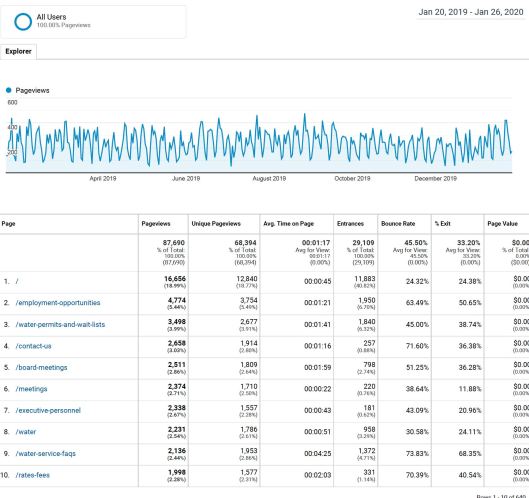
The CCSD site has been recently overhauled and has become more user-friendly. According to the data collected by Google Analytics and provided through the Public Records Request process (accessible through the website,) a good number of people use this tool to gather information and seek answers to ongoing puzzlements.

From January 20, 2019, through January 26, 2020, the Cambria Community Services District website was accessed 87,690 times, with 68,394 unique page views. That is a pretty good amount of traffic, though the top pages were a bit of a surprise.CSDWEBTRAFFIC

The complete list of results can be found in the following link:

CCSD_CombinedWeb

The Healthcare District website is currently undergoing a redesign, with the goal of making it both user and administration friendly. The work is being done by an active District employee, often in his free time, so it might take a while before it is ready for publication.

Widen The Lens

There has been a sporadic outcry around CCSD directors and staff using electronic devices during meetings, with the subtle and occasional direct accusation that all manner of nefarious communication was happening between board members and mysterious influencers and special interests.

Rather than rail against the perceived downside of electronic communication, why not embrace the potential and expand its use? Open a web channel to the meeting that would allow viewers to submit questions or comments to the presiding clerk, have the item read out loud, and have the written/electronic dialog entered into the minutes. Viewers who wish can ask their questions or make comments through the microphones on their computer, tablet, or smartphone. Brave citizens having a good hair day can turn on their camera for their allotted three minutes. More people will have the opportunity to “speak” to the board, staff, and community without the challenges of having to physically be “in the room where it sometimes happens.” Caller number five could win a toaster!

Businesses engage with clients all around the world in this fashion, using video and audio to make personal connections that increase understanding and decrease uncertainty. Participants can make “eye contact” through video, exchange written comments and conduct Q&A through chat/messaging features, upload documents for review and comment in real-time. Tone, tenor, facial expression, body language – all contribute to a complete dialog.

But..but…Cambria has old people who don’t use computers!

Really? Take a look at local social media sites and get back to me!

Let’s try it!

Shot Clock

Public commenters are limited to three minutes per item, with the board President controlling the clock and having some discretion with the time.

I suggest the same (or even shorter) time limits should apply to each board member who wishes to speak on a topic. Yes, the dialog between the members is essential and should happen freely. It is sometimes the case, however, where a director will go on a ramble. That suggests a lack of preparation.

Put together a compelling thought and present it in a manner not requiring a map, a compass, a dictionary, and some of that free coffee from the back counter. Each director should prepare their thoughts in advance and know what points/questions/positions they wish to share. Write it down. Read it back. Time it. Edit. Repeat. Speed up the meetings and reduce much of the frustration of fellow directors, staff, and the public who are trying to follow along. It may seem like this would limit dialog, but in my view is it would make dialog more effective and drive better results.

Takeaways

Even with all the efforts to communicate critical information throughout the community, there are, and will always be, gaps in our collective knowledge. Information is everywhere, we just need to look, ask and at times suggest better ways to share what we know, and what we would like to know. This community is blessed to have a good number of people who help all of us stay smart and safe. But as we are often reminded, we are each responsible for our own well-being.

Just because we may not know something, that doesn’t mean it’s unknowable. As Pinocchio tells us – we all have potential!

Share this:

  • Click to print (Opens in new window) Print
  • Click to email a link to a friend (Opens in new window) Email
  • Click to share on X (Opens in new window) X
  • Click to share on LinkedIn (Opens in new window) LinkedIn
  • Click to share on Facebook (Opens in new window) Facebook
Like Loading...

Delivering The News

13 Wednesday Nov 2019

Posted by Michael Calderwood in Communicating, Local Journalism, Words matter

≈ Leave a comment

Tags

CalPoly Journalism, Cambria, Jim Lemon, Joe Tarica Editor, Judith Pratt, Karen Garcia Journalist, Kathe Tanner Journalist, KCOY/KEYT, KSBY, Local Broadcasters, Local News, Megan Abundis, Reporters, Richard Gearhart, Scott Hennessee, SLO New Times, SLO News, SLO Tribune, Social Responsibility, The Cambrian

As an avid consumer of local news, I have preferences and opinions on how it is gathered and distributed across different media. At times I am quite impressed by the level of quality and professionalism on display, and at other times I find myself grumbling, “you know we can see you, right?” at the television. I find myself equally split as I peruse local and regional web-only publications, wondering if Strunk and White have gone the way of Perry White.

Television news has a particular impact on local communities. The reach and visibility extend beyond the screen, with many of the news teams supporting different communities and local organizations through public appearances, speaking engagements, and giving campaigns that benefit the locales they cover. These public service engagements leverage the “News Personality” appeal of broadcasters.

Print journalists are more often unrecognized as they move about the communities they serve. The work they do is valued by the words they share, without the benefit of the catchy jingles or exciting graphics. Their voice is not the one we hear; it is the one we read.

The Challenge

Consumers used to have to go to the media to get what they needed. Today, the media has to go to the consumer, finding them where they are. Business models morph as technology and culture change. Revenue streams once counted as subscription rates and advertising blocks, now include clicks and listens. The ability to watch or read content when the consumer wants it, rather than when the media outlet serves it up fresh, changes the weighted value of traditional metrics.

Advertisers now have a more extensive range of data points they can study to determine the effectiveness of their marketing spend. These metrics can drive those advertisers to different channels, which in turn forces the media companies to re-balance their portfolios to retain both consumers and clients.

The stories and rumors once exchanged over the clothesline are now bulk-loaded into the leaky washing machine of Facebook groups and Nextdoor pages. Technology has made anyone with a smart device and an appropriate vocabulary an instant expert. Jumbles of fact, opinion, and occasional malice get tossed, untreated, into the spin cycle, and often end up dirtier and nearly unrecognizable.

Yet, even with all of these challenges, local news continues to inform readers and viewers through their primary outlets. More often than not, it is done well. Still, I had some questions about the consistency of the products we get here in this beautiful region.

Inside/Outside

What motivates the broadcasters, print journalists, and the news organizations that serve the area? How do the local broadcasters and print journalists adjust to the non-stop changes?

I sent out a series of questions to journalists across the region, looking for insights that would help me better understand the world of local news through the experiences of those who do it for a living. I sought input from on-air talent, by-lined reporters and writers, and producers and editors responsible for the news consumers see, read, and hear. I also sought input from educators who teach the technical, communication, and presentation skills that apply across all channels.

The response was mixed, with some journalists sharing thoughtful responses and helpful information. Some organizations were less open. Requests for comment, as they say, went unanswered. Maybe I was asking the wrong questions or using the wrong approach. Perhaps I need to get a better reporter on the case.

The first rule of Fight Club is you do not talk about Fight Club.

As I progressed through the research portion of this endeavor, I realized that I was focusing solely on the outlets that I see and read. I was ignoring the obvious – the overall population in the region is quite diverse, and for many, English is not the primary or most comfortable language. So how do broadcasters reach these sections of the overall community? I don’t know…yet.

Broadcast News

Local broadcast news on the Central Coast is different from what I watched back east. In New York, NBC = channel 4, ABC = channel 7, and CBS = channel 2. This format held when I lived in Connecticut with network parents and local affiliate news organizations airing in regular time slots on their dedicated channels.
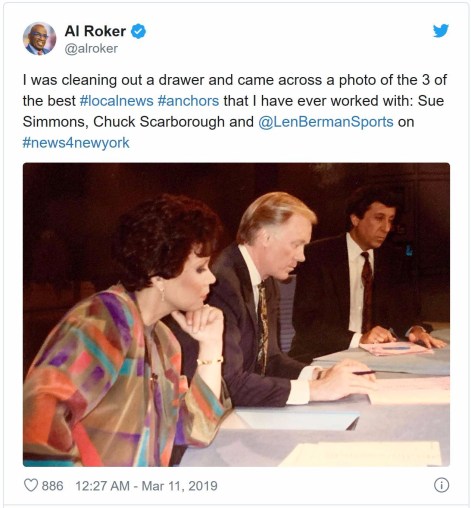
RokerTweet

NBC New York featured Sue Simmons, Chuck Scarborough, Len Berman and a young Al Roker. The prototype for a local news lineup – dual anchors, weatherman/personality, and sportscaster.

After moving west, it took some time to adjust to a very different television news landscape. The same newscasters appear on different channels, with multiple network affiliations. Some newscasts run simultaneously, and others in air consecutive time slots.

The Market

According to the 2019 Nielsen DMA Rankings, the San Luis Obispo-Santa Maria-Santa Barbara market ranks #124 of 210. Relatively close markets include Fresno – Visalia at #54, Bakersfield, at #122. Los Angeles ranks #2, and the San Francisco – Oakland – San Jose market comes in at #8.

The Teams

The Central Coast has two primary English-language news organizations that broadcast on multiple networks. Broadcasts are sculpted to target specific geographies, though both groups strive to be inclusive of content that is of interest and importance to nearby communities. Roughly speaking, the team from KSBY News focuses on San Luis Obispo County, and the KCOY/KEYT group covers Southern San Luis Obispo down through Santa Barbara county.

The two organizations rely on a core group of experienced anchors, reporters, and forecasters. Both serve as a training and development platform for journalists, producers, and directors who are new to the world of professional broadcasting.

The Veterans

Richard Gearhart is a long-tenured member of the San Luis Obispo based KSBY news team. He currently serves as an anchor on the evening broadcasts. He is also an associate professor at California Polytechnic State University. (Cal Poly)

At Santa Maria-based KCOY, anchor Scott Hennessee quarterbacks multiple evening broadcasts. Jim Lemon is the News Director for KCOY 12.

The Question

The primary question I posed to each journalist was the same – Do you see your job as a journalist, news personality, broadcaster, or other?

Scott Hennessee replied, “Everyone in our newsroom is a journalist first. When I’m on the air, I’m a broadcast journalist communicating information as clearly and accurately as possible. I don’t necessarily see myself as a TV personality. There are occasional opportunities within the newscast to show some of my personality, and I’m always happy to meet new people out in the community, whether they watch our news or not.”

Richard Gearhart has a similar view. “I think of myself as a journalist first. TV journalism right now is a bit personality-driven – the reason is more about credibility than personality. News consumers are looking for trustworthy sources. They “know” their local anchors and reporters and hopefully trust them.”

Jim Lemon added, “For what we do, journalist is first and foremost. There are occasions (hosting the Turkey Drive, the Rodeo Parade, etc.) where “personality” comes into play, but even then, at the foundation, we’re journalists. We’re also broadcasters in that one of our mediums (television) is that field. We also provide content on digital platforms, which brings it back to the overall “journalist” description.”

Anchors

An anchor’s job requires a diverse set of talents. Jim Lemon describes the must-have skills for the position. “The anchor is a good leader in the newsroom. He or she communicates well while keeping track of other things happening during the broadcast.” He continues, “A successful anchor also takes a direct role in ‘how’ and ‘what’ is written in copy. In local markets, it also includes being interested in the community and ways to enrich/enhance it.”

Scott cites experience as the best teacher when it comes to anchoring – the more you do it, the more comfortable you get. He believes that knowing the history of the area can help bring some perspective to his reporting. “I’m always seeking out information about all kinds of things news and culture – related that help me have a greater understanding of the stories we tell.”

Mentors

Local news organizations are fertile ground for developing talent. Many producers and directors that staff the broadcasts tend to be in the early stages of their careers. Both these veteran anchors guide and mentor on-air talent and behind-the-camera personnel.

As a news director, Jim observes that in smaller markets, anchors often have much more experience than those around them, especially producers. Therefore, primary anchors have a de facto leadership responsibility. Both Scott and Richard echo Jim’s observations.

Scott expands, “I have had occasion to work very closely with producers who are new to us. Once they get the hang of things, it is wonderful to see them flourish. Most of our producers are here for 2-3 years, and almost all of them move on to the top 30 media markets.”

Richard agrees. “In our case, producers and directors tend to be at the “early career” level. So here, the anchor team, to a certain extent, oversees the producers.” One of Richard’s objectives is to coach newer multimedia journalists. He is currently mentoring two reporters.

Direction, Tone and Content

Scott’s description of how the broadcasts come together is similar to organizations across the country. An assignment editor gathers story ideas from outside sources, reporters, and anchors. The stories are discussed at two daily editorial meetings that focus on daytime and nighttime broadcasts. The selected segments are then brought up to a broadcast-ready level. Feedback happens in a nightly post-newscast session.

KSBY’s current owner (E.W. Scripps) has a long history and an excellent reputation in the field of journalism. Corporate has a content management division, and both local and home office management keep a close eye on what’s happening. The news team also gets a surprising amount of feedback from viewers.

Jim Lemon, KCOY News Director – In college, we learn the legal aspects of journalism: defamation, libel, the 5 Ws and the H. Once in the field, it’s about experience, learning from your colleagues, and keeping an eye on national or local trends.

Everywhere

Both organizations are embracing additional digital outlets, primarily social media. Facebook and Twitter feature feeds from the parent stations and the individual members of the broadcast teams. Live streams are used to break the news, share behind the scenes glimpses of productions, update in-progress sporting events, and tease upcoming broadcast stories.

Websites are regularly updated and tweaked to be easier to navigate. The presentation elements of promotional clips, talent features, and branded shows play out across every channel, complete with upbeat music, quick-cut video, and scenic backdrops that define the region. The recently updated KSBY studios sport a modern look supported by bold colors and attractive graphics.

With all of that, however, it comes down to the talent. They go after it all day, every day. Sometimes they make one mutter.

And there are the shining moments of excellence.

From the Front Lines

Live and Local

California’s 2017 – 2018 fire season was brutal. Explosive wildfires and the associated threats that came along with the flames tore through dense forests and threatened multiple communities.

Local and national news organizations sent in teams to show the public what was looming over the glowing hills.

At local NBC affiliate KSBY, it was all hands on deck. Anchors, multimedia reporters, and even the sportscasters picked up a microphone, put on a windbreaker, and went out into the field. These critical communicators worked endless shifts under incredibly dangerous conditions. Many a live update ended abruptly, with reporters being told to get out of the area quickly. They moved a short distance away, reestablished communications, and resumed doing the critical work of telling the evolving story.

Watching these reporters – many of them young women and men early on in their careers – was fascinating. They rose to the challenge, balancing their physical safety with the need to get close to the unfolding events. Absent the time and safe workspace to build and edit the story, they went live and delivered outstanding work. The core skills, talents, and personalities of the reporter were on display. They managed through briefings with emergency response managers and terrified residents, delicately asking difficult questions of people at their most vulnerable.

As the battle wore on, viewers could see the toll this was taking on the reporters. They saw it all, from devastated residents to exhausted first responders, and they told the stories while absorbing the collective weight of global suffering and danger.

And they did all of this for days on end.

“I Am A Journalist”

Among those determined reporters, Megan Abundis’ work stood out. She charged into the story with intense focus and genuine concern for those who were in the unpredictable path of the relentless fire. Megan delivered her updates with the skill of a veteran field reporter and the fearlessness of youth.

“I am a journalist,” Megan states with conviction. I take my job incredibly seriously. Reporting at those fires really meant a lot to me. It was a heavy responsibility, and each day was harder than the next. I think about that mudslide and fires more often than not.

MeganAbundis

Megan Abundis

Megan continued developing her skills on the Central Coast, rotating through assignments that included field reporting, occasional weekend anchoring, and weather (everybody does the weather.) In a performance that left the rest of the news team slack-jawed, she delivered a sports report that was ESPN-worthy.

Earning It

Megan earned a Communication degree in Broadcast Journalism from Washington State University, Pullman. During her four years at WSU, she did multiple, cross-discipline radio and television internships. These stints gave her real-world experience in professional news writing and producing.

Upon graduating, Megan followed the path familiar to many in broadcast journalism, landing a job in a smaller media market. She shares, “KSBY was my first job. I was able to learn and grow immensely because of the staff and mentors there.”

Moving Forward, Reaching Back

Megan takes ownership of her career development. She attends industry conferences, follows the work of her role models, and, as she says, by “reading, reading, reading!”

She is a role model for the next generation of journalists. She advises students at her Alma Mater, preparing them for the transition from student to professional, setting expectations for what they can expect from their first job.

Megan’s career path has taken her to KOB-4 in Albuquerque, New Mexico ( #47), where she collaborates with a team that includes the news director, executive producers, assignment desk editors, web staff, and fellow reporters. She holds a place in her heart for her first professional job.

“I am very thankful to KSBY viewers for learning and growing with me. My first reporting job was nothing but great! ”

New Faces

The stream of new faces that roll across the local screens gives a glimpse of just how many aspiring broadcast journalists are competing for the opportunity to build a career. Many of these faces are fresh out of college, and some are transplants from other markets across the country.

For the rookies, landing a spot comes with some real struggles. Compensation is minimal, while the cost of living in the San Luis Obispo region is challenging for many established professionals in any career.

A scan of several job tracking sites confirms the compensation reality. Anonymous comments from current and former employees underscore the challenges of living in a high-cost region.

“The pay is the only thing that makes people look elsewhere. Unless you’re already in a more senior position (anchor/manager), it’s unlikely you’ll have the ability to stay here beyond paying your dues for a year or two.” Taken from an employee review on Glassdoor

In an informal conversation, an aspiring reporter from one of the area broadcast organizations shared the frustrations of building a resume, learning the region, dealing with unpredictable shifts, all while living over an hour away because that was the only reasonably affordable place to live. A second reporter made ends meet working in the foodservice industry while building a portfolio of increasing depth. These stories are familiar among many young professionals, though few other jobs place neophytes in the public eye, where they have to appear sharp, focused, and confident while on camera or in print.

Experienced Eyes

Judith Pratt is a retired professor emeritus of California State University, Bakersfield, where she taught Communications for 31 years, focusing primarily on journalism and gender studies. Prior to Cal State Bakersfield, Judith was a journalist in Bakersfield and before that, in Canada. I reached out to Judith to get her views on the state of local news in general, and her observations on how our area outlets are doing.

Judith echoed the economic challenges new reporters face, describing one Bakersfield news person’s early career as a week-day reporter and weekend waitress. Aspirants accept that the entry-level pay scale is low. They have few choices, needing the experience to build a resume that will lead them to the next level or a larger market.

For some, Judith observes, this challenge incites the competitive spirit and unlocks the characteristics that build solid journalists. The good ones maximize their experience and move on to the next opportunity — the less successful migrate into other areas of the profession, or different businesses altogether.

Shared Experience

Judith keeps an eye on the local media scene from her home in Cambria. Many of her observations aligned with my own, though her personal experience added great depth to my understanding. She pointed out a few areas that I had not considered, such as the importance of local sports coverage in small and medium-sized communities. Local sports are often a common rallying point. Good local coverage helps build community pride and involvement. A feature article or a highlight reel finds a way to family members who live in different towns or states. Grandparents still keep press clippings, and young athletes find inspiration and motivation through positive attention.

Less is Less

Providing in-depth coverage of school board meetings, local political goings-on, and projects that affect communities is a challenge. There are not enough reporters to cover everything, so alternative outlets often fill the gaps left by downsized media.

Judith uses her experience as a journalist to build an example of this diminution. In earlier times, local media would do an excellent job of taking a national issue, such as tariffs, and bring it down to the local level. Almond growers, in her example, are hit with tariffs that raise the cost of exporting the product to overseas markets. Those increases affect local growers, who see their output sit still, not generating any revenue. This loss of income then impacts local budgets, as the taxes paid are reduced. At the same time, the grower tightens the family belt, reducing the amount of money spent with local suppliers.

Good local reporting would, in the past, follow the chain of events, explaining the cause and effect at each stop, personalizing and humanizing in ways that resonated with the reader. Some outlets still do these types of stories, but they are as likely to be delivered as a podcast as a by-lined newspaper story or a local broadcast news feature.

The journalists who contributed to this piece validated Judith’s observations.

Teach Them Well

The commitment to developing journalists Judith experienced at Cal State Bakersfield is also found closer to her current home.

San Luis Obispo, located between the major markets of Los Angeles and San Francisco, is home to California Polytechnic State University – better known a Cal Poly. As the name implies, the curriculum approach is multi-dimensional. This philosophy extends across the disciplines from Engineering, Agriculture, Performing Arts, Graphic Arts, and Journalism.

From the University’s website:

Cal Poly’s Journalism Department is one of California’s most innovative undergraduate journalism programs, among the first in the country to take an integrated approach to student media, mirroring developments in the industry. The department embodies a polytechnic university philosophy, offering a technology-rich, student-focused environment that fosters student curiosity and entrepreneurial spirit.

CPLogo

Learn By Doing

Cal Poly has an impressive range of student-staffed and run media outlets under the banner of Mustang Media Group. Here, professors guide students as they move from the classroom to the newsroom. The forward-thinking department has created an integrated multimedia organization where students can do the actual work of journalism. The department recognizes that to be successful in a journalism career, students need to be skilled in a range of communication styles. Specific tools and required technical knowledge may vary from discipline to discipline, but the skills of collecting, constructing, producing, and communicating information are core to every channel.

Professors Brady Teufel and Patrick C. Howe collaborated on a terrific case study detailing the Cal Poly project to create an integrated media operation. They are published in College Media Review/ Journal of the College Media Association.

The Best Medium for the Story – A Case Study of Integrated Student Media

Though focused on transformation in the academic environment, the work described, and the results achieved seem to be entirely translatable to the world of commercial journalism. Most of the goals and desired outcomes would look right at home in any media business.

Outcomes:

  • More thorough news coverage
  • Increased revenue and reach
  • More experimentation
  • Positive culture shift
  • Increased recognition
  • Public Relations Integration
  • Curriculum improvement
  • Leadership structure changes

Classroom to Newsroom

The continuum of University student to a professional broadcaster is exemplified by current Daybreak anchor Christina Favuzzi, who joined the KSBY team in 2015 after earning her degree in broadcast journalism from Cal Poly. In her current role, Ms. Favuzzi delivers a mix of news, weather, local happenings, and human interest stories from the anchor table and the field. Christina and the Daybreak team utilize both the daily television broadcast, and regular social media live streams to deliver the news with a personal and at times, informal style. Much like the hosts of the national Big Three Morning programs, the Daybreak team is a blend of journalists, News Personality, and broadcaster.

Megan Healy is another Cal Poly graduate who is making quick strides at KSBY. After graduating with a degree in Journalism, Megan joined the station as a multimedia journalist, and within one year was promoted to a spot as weekend anchor.

Cal Poly is also well-represented at KCOY/KEYT. Managing Editor Ed Zuchelli is a third-generation Mustang. Lindsay Zuchelli serves as the Executive Producer for KEYT-KCOY-KKFX.

CalPoly’s contribution to the local media landscape extends into the world of print journalism. Tribune editor and columnist Joe Tarica shares, “The Cal Poly journalism department gave me all the tools I needed to start my career. I learned reporting, editing, design, photography, etc., in class and the lab that was Mustang Daily. I was ready to work right out the door.” SLO New Times staff writer Karen Garcia also credits her Cal Poly experience for her development as a journalist.

Print Journalists

All The News That’s Fit

In the New York of my youth, Print Journalism stood equally tall alongside broadcast news. The NY Daily News and The NY Post battled it out for tabloid supremacy. The New York Times provided both intellectual and physical heft to mix. Regional papers like Long Island’s Newsday and Westchester’s Gannett papers covered the suburbs and the places where boroughs rubbed up against towns. El Diaro served the Spanish-speaking communities, while The Irish Echo catered to families who had emigrated from the Emerald Isle.

The legendary Village Voice filled the Weekly Alternative slot. Deep-thinking novelists shared pages with political pundits, music critics, neighborhood gadflies, and endless classifieds for everything from help-wanted to Times Square sex shows. Buried in these pages were greats and soon to be greats like Norman Mailer, Jack Newfield, and Michael Musto.

There are parallels with today’s newspaper landscape here on the Central Coast. Two, in particular, stand out, with a third being a hyper-local subset of one.
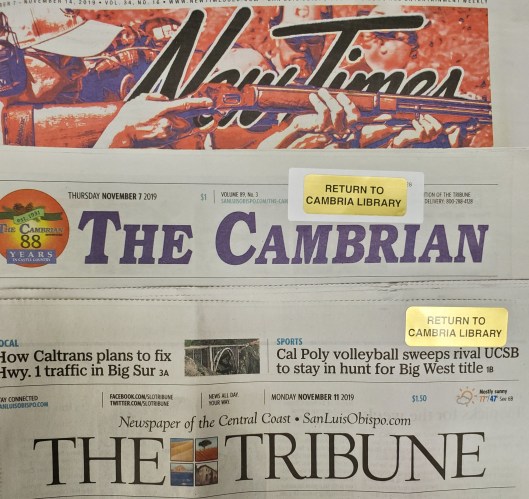
20191112_165355.jpg

Cambria Library has the news

The Tribune is similar to the Gannett Westchester papers, covering the region and the unique cities, towns, and populations that fall within the geography. New Times has echoes of The Village Voice in both content and attitude.

The Cambrian and parent Tribune both carry a newsstand price and various subscription options that span the printed paper and the digital offerings. New Times is free to readers, with a healthy mix of advertisers fueling the economic engine that keeps the weekly going.

Mighty Pens

I had the great pleasure of exchanging thoughts with three area print journalists, each at different points in their careers.

Joe Tarica is the editor of the Tribune. He is also an opinion columnist when the mood or the topic strikes him. Joe began his career at the then Telegram-Tribune as a copy editor in 1993.

Karen Garcia is a staff writer for alternative weekly SLO New Times. She is a relative newcomer, currently in her third year as a professional journalist.

Kathe Tanner is a reporter/columnist for The Cambrian, the local outlet for The Tribune. Kathe joined The Cambrian in 1981 as a columnist and has also worked as an advertising, radio, and television copywriter. Kathe has been honored with nearly three dozen first – or second-place individual awards from the California Newspaper Publishers Association, including one for the best journalistic writing in the state in 2003.

JoeKarenKathe

Journalists Joe Tarica, Karen Garcia, and Kathe Tanner

Even with differences in age, experience, and audiences, the similarities to each other were striking. Perhaps some traits are unique to print journalists. Here’s an example – I asked what drew them to careers as writers and journalists.

Joe Tirica – “I knew I wanted a job in communications because English was my favorite subject. I also had a strong belief in freedom of information and the First Amendment and their importance to our democracy. So journalism was a natural fit for a college major that would yield a sensible job.”

Kathe Tanner – “I’ve been a writer all my life, writing grammar-school English essays about “Grammar and her grandchildren, “Adjective and Adverb.” She also converted a middle-school history assignment into a statistically accurate Richard Armour-style essay. (The teacher failed it, saying, “There’s no place in history for humor.” I told him, “Then you’ve been reading different textbooks than I have.”)

Karen Garcia – “I loved English classes in high school. I was always asking questions, discussing what was going on in the news with my mother. I was drawn to journalism because it’s a platform to ask questions, find out how people think, and understand how events, policies, and decisions affect a community.”

Finding The Story

All three journalists describe the general process for determining what is covered and what is published. At The Tribune, reporters pitch stories from their beats, which are evaluated for substantial value and interest to the community. As an Editor, Joe ensures the team is covering the best local stories, while also building higher-level enterprise coverage strategies that determine what projects to tackle. Joe details the objectives and guidelines; “Here, we are looking for impact and change. What are the most important issues to our communities, and how can we inform the public and motivate action?”

For Karen and her New Times colleagues, the thought process is similar. The staff members have areas they cover and determine what stories they feel will be impactful and informative. She describes a highly collaborative environment, rich with mentors who share their knowledge and experience in the service of the story. The journalist writes the story, and the team provides support and guidance.

As the primary representative of her paper, Kathe has to evaluate the entire Cambria landscape and determine what of the many goings-on are most important, most interesting, and most entertaining. She has to balance a plethora of monthly Board meetings – Cambria Community Services District, Healthcare District, School Board, and North Coast Advisory Committee are the most visible. There are a host of other organizations that are active and newsworthy, so they are part of the coverage equation. On top of the steady-state goings-on, newsworthy events pop up all the time. Police activity, fires, car crashes, at-risk citizens, earthquakes, power outages – the pool of potential stories run deep.

Styles

Both Kathe and Joe write columns, Kathe, on a more regular basis. Joe has more latitude in choosing when he writes. His passion and sense of fairness is often a catalyst. As he says, “When I write, I’m mostly driven by outrage about a particular subject. Because I don’t write often, this is usually a pretty high bar.”

Kathe often bases her columns on life as a community member, a wife, and a matriarch. She uses humor and self-awareness to great effect. Within her columns, light-hearted as they are, readers will find multiple bits of useful information and a sense of historical perspective. Whether it is Cambria-specific or call-backs to earlier times in her life, Kathe ties it all up into a pleasant read.

Kathe shared the challenges of being a reporter in the community she has called home for decades. “I had to stop serving on various nonprofit boards because, as our reporting staff kept getting smaller, my “beat” got larger, and I had to cover those activities. A responsible journalist doesn’t serve and report on the same things.” She also has to report on people she has known for many years, sometimes in unfavorable circumstances. “I’ll always bend over backward to be fair,” she shares. This fairness means asking the tough questions, listening to the answers, and reporting the subject’s side of the story.

Karen’s position with New Times allows her to work in her favored style, which is longer-form, multi-layered journalism that blends topical news with human interest. Her recent series on the students of The Grizzly Academy is a perfect example of her strength. This series follows her earlier, compelling look at the impacts of immigration policy on local residents touched by forced separation. On the traditional local news beat, Karen explored Fire Services across the area and reported on individual town and regional challenges while keeping sight of the big picture of just how connected the underlying issues are.

Karen is a big fan of NPR radio. It is the soundtrack to her daily drive to work. She has an appreciation for the depth and nuance of the interviews and investigative reporting that are the hallmarks of the genre. She described enjoying the atmospherics of crunching leaves and snapping twigs, faintly heard behind an interview conducted during a walk in the woods. This type of color is challenging to recreate in a written piece, but there are hints in some of Karen’s most insightful work.

Challenges

Traditional print journalism is under constant pressure to capture and keep readers and advertisers. Like any business, revenues drive resources. Declines shrink the number of reporters, editors, photographers and support staff that are the lifeblood of any newspaper. Still, the news must be covered.

Generational behavioral shifts, fueled by technology advances, are changing how print organizations are covering and reporting. The costs to print physical papers do not go down with the number of copies sold. Technology helps a bit on the production side, with digital tools accelerating how stories are compiled, edited, and sent to print. High-speed digital printers ingest a large amount of data efficiently, and automated workflows handle the process of printing and finishing the paper. Print runs are scaled down or up based on analytics and smart editors who gauge the potential readership by the content of a particular edition. Art and Science meet at the speed of today’s 24-hour news.

All of this automation and digital connectivity means newspapers are produced and distributed from locations around the state. Larger publishers now consolidate multiple publications into a single print facility. Smaller papers have access to the same production processes.

Production efficiency is just one part of the overall technology equation. The biggest threat and opportunity for traditional print media is the internet. Publishers large and small are continually adjusting to the reality of on-demand information. Journalism continues, but the journalists approach their work in different ways.

A New (Virtual) Reality

Journalists are facing the same opportunities that every marketer, retailer, credit card company, and utility face when building and maintaining a dialog with their customers. Technology moves quickly, demanding the attention of both the business and creative brains to create excellent, relevant content, and deliver it to consumers wherever they want it.

A simplistic view – it’s the internet, how hard can it be? The reality – the internet is the highway to webpages, integrated news feeds, stand-alone applications, tweets, Instagrams, and text alerts. Information lands on multiple device platforms, from cell phones to tablets, computers, even smartwatches. It isn’t one font fits all; its all fonts behaving differently on different screens.

Joe Tarica captures this new reality. “Print journalism is more important now than ever, but we must ensure we’re paying as much attention to where we can respond the quickest and reach new audiences. We need to be open to using new tools and adapting rapidly.” In Joe’s world, digital media, rather than a printed newspaper, is becoming the default platform. The aim is to meet readers where they are or will be: on the website, mobile platforms, social media, and through alerts and newsletters.

Social Media – Friend or Foe?

All the journalists understand that social media presents excellent opportunities to reach readers/followers quickly and accurately when needed. It also serves as a platform to connect with the communities they cover, build relationships and establish credibility, and develop new sources of information.

Karen will, on occasion, post to multiple Facebook groups and solicit thoughts and opinions relevant to the story she is building. These outreaches, done in an open forum, gives her a glimpse into the different views a community might hold, which adds depth and perspective to the story.

Kathe takes advantage of social media to get the time-sensitive information out quickly and follows up with in-depth reporting in the weekly Cambrian. Often, her stories will feed into the broader Tribune ecosystem, where they link to similar events in neighboring communities. This timely local reporting is critical in an area where the threat of wildfire and other potential natural disasters is ever-present.

Benefits and Dangers

Each of the journalists also addressed the risky side of social media. They expressed concern that posts that may appear reliable and respectable may not be either, but rather opinion or propaganda disguised as news. Each cited examples of posts that were neither fact-checked or scrubbed for bias but were absorbed by readers as legitimate news sources.

Kathe muses, “It’s another way for a traditional journalist to keep in touch with the community, feeding news to them and tapping into what else is happening on his/her beat. Danger? When people automatically believe what they read online, without crosschecking with known, responsible media outlets.”

Joe adds, “The benefit is you can get informed about your community in all sorts of new ways. The danger is that many sources don’t follow professional standards. So they may tell you something that is partially true, but is it handled in a fully responsible and ethical way?”

Committed

As writers and reporters, each of the journalists recognizes that whatever outlet they use, the high standards they embrace in print must apply to every digital mark they make.

“News is an important way to preserve history,” Karen Garcia believes. “It gives a voice to underprivileged and under-served communities. It is motivating to know that there are people who trust you to tell the truth and present the facts. It’s a weight you carry as a journalist.”

Joe Tarica continues to believe in the importance of the First Amendment and the role of journalists. “The democratization of news has only made the role of professional news organizations more important, because not many people or places can invest the time, energy, and proper training, to tackle the most difficult and significant stories.”

As a long-time member of the community, people look to Kathe when things happen. They also see her as “the keeper of the scrolls” with an institutional memory that brings perspective to recurring hot-button topics. For Kathe Tanner, being a journalist for the community she has called home is both a joy and an obligation.

Finally

To hijack an old expression, “all news is local.” The people who do the hard work of keeping us informed about what is happening in our communities deserve both recognition and support. Without them and the organizations they represent, we might as well make up our own versions of history. They also need to be held accountable and connected to the communities. When they say “we want to hear from our viewers/readers/subscribers,” – believe them. Let them know what you think and what you need from them.

The good ones will always listen.
Share this:

  • Click to print (Opens in new window) Print
  • Click to email a link to a friend (Opens in new window) Email
  • Click to share on X (Opens in new window) X
  • Click to share on LinkedIn (Opens in new window) LinkedIn
  • Click to share on Facebook (Opens in new window) Facebook
Like Loading...

Saturday Sessions – Water Works

07 Saturday Sep 2019

Posted by Michael Calderwood in Beautiful Cambria, Cambria CCSD, Communicating, Community Involvement, Educating a Community, Local politics, Searching for Cambria's Reality, Words matter

≈ 2 Comments

Tags

Cambria, Choices, Community, Community Involvement, Leadership

Remote Thoughts – Home Viewing Version

(or, How I Spent Mike Lyons’ Birthday)

The tradition of Cambria’s Saturday morning community forums continued September 7 with a session focused on the town’s water supply systems, and particularly the “EmergencySustainableAdvancedWaterFacilityMachineSystem” ™ patent and permit pending.

Cambria Community Services District Board President Dave Pierson, resplendent in navy blazer and open-collared, pinstriped button-down shirt, facilitated the forum. Attendees and viewers received a well-crafted and smoothly delivered fact-and data-filled presentation. Those at the Vet’s Hall enjoyed a tantalizing and delicious (I imagine) array of freshly baked cookies created by the delightful and community-minded Karen Dean.

The session was thoughtfully constructed and delivered by the team of former acting General Manager and current district consultant Paavo Ogren, data and administration analyst Melissa Bland, and water systems leader Jim Green. Each of the presenters stood as examples of skilled, experienced, and capable personnel that staff critical roles in the Services District.

Talent

Mr. Ogren demonstrated his grasp of the complexity of the issues and brought an interesting outsider/insider perspective from his previous work in county planning through his tenure with the CCSD organization and administration.

Ms. Bland took us back to what seems like a reasonable point in time – 1990. She did an excellent job, walking through a series of statistics, requirements, and point-in-time events that led to the current state of Cambria’s water situation.

Mr. Green then took the mouse and did a great job of again mixing data, regulations, and requirements, and actions are taken to maintain and expand the systems that deliver Cambria’s precious water supply.

All three presenters addressed many of the questions, opinions, and assumptions that have clouded the critical discussions around Cambria’s water facilities.

Complex Questions, Honest Answers

After the presentations were complete, President Pierson read questions submitted by the public. The questions were thoughtful and detailed. Many were based on technical, environmental, and regulatory factors; some were both complex and carefully worded. Mr. Ogren skillfully answered one such question by pointing out that based on the wording, the answer was “no,” but he then dug down into what he saw as the intent behind the question. His subsequent answer was much more helpful.

Some of the questions made me wonder, “what is this all about?” and “what is the goal of asking that?” To the credit of the panelists, each question was answered thoughtfully, and explanations were put into the broader context of the issues being discussed. I really appreciated that approach and found that my field of vision was widened as I saw how the panelists listened and responded. Mr. Ogren’s description of “adaptive management planning” was a “duh” moment for me!

President Pierson also had a strong moment, stopping some guesswork responses with a firm statement: (paraphrasing) “This is about facts and not guesses.”

Takeaways

It is clear that the CCSD has talented, thorough, and involved employees and leaders who are serious about what they do for the community. These folks know their stuff. They are clear communicators, experts in their areas, and understand how to connect the dots across what is often a confusing landscape of issues and solutions.

The issue of cost will continue to be painfully present in all discussions. It was encouraging to hear future-focused, practical and pragmatic positions from some of the board, alongside the constant drumbeat of negativity and solution-less posturing from less visionary members. To me, the contrast between investing and building for tomorrow or destroying progress to save yesterday was stark. And needed.

It comes back to the eternal question of what we expect from an elected representative. Some favor a person who will act as an amplifier of a particular position. Others favor someone who will use their best judgment and act based on what they believe is best for all.

I admire the courage and conviction it takes to stand on principle, regardless of which perspective one favors. It is easy to be a dilettante. It is noble to raise the hand and say, “I’ll do it.”

Why made this session valuable? Hyperbole was muted, opinion replaced with fact. The table was properly set with a beginning, middle and ending. Complex things became much simpler to understand and assess.

The event was broadcast and recorded and will be available for viewing over the coming days at the SLO-SPAN website. It is worth watching, even without the cookies.


Share this:

  • Click to print (Opens in new window) Print
  • Click to email a link to a friend (Opens in new window) Email
  • Click to share on X (Opens in new window) X
  • Click to share on LinkedIn (Opens in new window) LinkedIn
  • Click to share on Facebook (Opens in new window) Facebook
Like Loading...

Community Part I – Our Brother’s Keeper

04 Thursday Jul 2019

Posted by Michael Calderwood in Beautiful Cambria, Cambria Schools, Communicating, Community Involvement, Emergency Services, Home, Homelessness, Living Our Values, Searching for Cambria's Reality, Social Responsibility, Words matter

≈ 1 Comment

Tags

Cambria, Community, Community Involvement, Leadership, NCAC, North Coast Advisory Council, Social Responsibility, Susan McDonald

The past few weeks have brought into focus something that I have been trying to capture about beautiful Cambria. The community was invited to attend two different town forums, both on topics that cut across all artificial barriers. Both sessions shared a set of common characteristics. First, they were led by top-shelf chairpersons. Both committees have an outstanding group of citizens who serve our community with passion and distinction. And both forums featured expert presenters who brought facts to what are often emotionally charged and occasionally hyperbolic topics – Homelessness and Wildfire Preparedness.

Session One – Homeless in the Community

The first event, hosted by the North Coast Advisory Council under the leadership of Chair  Susan McDonald, offered an in-depth discussion of homelessness in the community. The council put together a panel of fourteen experts who represented governmental, faith-based, and non-profit organizations that deal with the myriad issues grouped under the HOMELESS label.

It was, at times, depressing, shocking, and despairing. But those moments were countered by hope, success, actions and intelligent determination to meet the issues where they are, and not accept the simple and superficial arguments that say there are no answers except the one that aligns with an individual’s worldview.

Stones in the Road
When we were young we pledged allegiance
Every morning of our lives
The classroom rang with children’s voices
Under teacher’s watchful eye
We learned about the world around us
At our desks and at dinner time
Reminded of the starving children
We cleaned our plates with guilty minds
And the stones in the road
Shone like diamonds in the dust
And then a voice called to us
To make our way back home
Mary Chapin Carpenter

Read Kathe Tanner’s excellent reporting on the Forum.

Homeless

What does “homeless” mean? There are as many variants as there are people, it seems.

People without a place to live due to a financial crisis or a health crisis.  Victims fleeing domestic abuse. People who have a mental illness, addiction, or untreated substance abuse problems.

There are the transients, the part-timers, the semi-homeless, the on and off again homeless. There are rotating families who struggle to find the ways and means to a permanent place. There are veterans and those who illicitly claim that status.

There are those who like the freedom of rootless life, who depend on the kindness of strangers for sustenance. There are those who similarly wander, but use other methods of extracting support from communities.

Kids

Most distressingly, there are, in Beautiful Cambria, almost one hundred kids classified as homeless. They couch surf or share grossly overcrowded motel rooms with others in similar situations. They rotate through homes and sheltered places, often claiming a corner of a floor or perhaps a shared bed. Sometimes they shiver in a car or a campground. That might be fun during an adventurous road trip, but not so much as a way of life.

As reported by a school administrator, there are 601 students enrolled in the Coast Union school system. Of those 601 students, 73.8% are eligible for nutrition assistance. That’s 447 kids. The meals provided by the school are often the only healthy food these kids regularly get.

The numbers seem to remain constant, but the faces change. Families who come to this area are looking for a place where they can build a decent life. They work hard, contribute to the community, and help make the local economy run, yet can’t get enough traction to sustain a permanent home base. So they move on to the next place and are replaced by the next group of hopefuls.

Solutions in Action

As the forum progressed, the experts on the panel stood up and answered the question, “What are you going to do about it?” It was heartening to hear the consistent answer – “This is what we are doing about it.”

Each presenter gave a straightforward description of what their organization does, the challenges they face, and the programs and approaches they rely on to provide critical services.

The level of cooperation and coordination was heartening. The inter-agency relationships painted a picture of the few doing the work of many. Churches and schools, CCSD employees and citizen-driven action committees are all taking on a piece of the challenge. From Veterans Services to Domestic Violence victim support, from the Sheriff to State Parks, the message that rang out was – it is not just “my” problem – it is “our” problem.

There are no rose-colored glasses here, but there is a lot of clear vision. The problems facing too many of us are real, and the impacts are not insignificant. The truth takes the heart in many directions. There is real human suffering, and in beautiful Cambria, it is met by true humanity.

For more detailed information, download the NCAC meeting minutes here.

The starving children have been replaced
By souls out on the street
We give a dollar when we pass
And hope our eyes don’t meet…
Stones in the road
Leave a mark whence they came
A thousands points of light or shame
Baby, I don’t know

Community, Part II -Knowledge in Action

Share this:

  • Click to print (Opens in new window) Print
  • Click to email a link to a friend (Opens in new window) Email
  • Click to share on X (Opens in new window) X
  • Click to share on LinkedIn (Opens in new window) LinkedIn
  • Click to share on Facebook (Opens in new window) Facebook
Like Loading...

Disaster At The Firehouse!

09 Tuesday Apr 2019

Posted by Michael Calderwood in Cambria Fire Department, Communicating, Community Involvement, Emergency Services, Home, Humor, Satire, Searching for Cambria's Reality, Words matter

≈ Leave a comment

Tags

Cambria, Cambria Fire Department, Community, Community Involvement, Emergency Services, Leadership

Part One – The Mistake

It started innocently enough, just another day in a long stretch of multi-day shifts. The duty crew was settling in for a fitful sleep. Reading lights glowed in small, spartan rooms. Each member of the service reading, texting, or relaxing, near rest but still on the edge of adrenaline known to those who answer the bell.
A television played quietly in the communal room near the back of the station. Jimmy Fallon was doing his usual “laugh too hard at his guest’s every comment” routine. The last few unpopped kernels of Skinny Girl popcorn (with sea salt) sat at the bottom of an old takeout carton from Robin’s. The empty cans of Red Bull lay in the recycle bin. The unique nightlight, thoughtfully provided for the new reserve who had not quite settled into the firehouse environment, glowed softly. Above the beacon sat the station’s whiteboard, tagged with a series of “To Do’s” and “who left the taco sauce uncovered???” complaints written in different colored dry erase markers. Each shift had their color, but as the ink ran dry, everything was captured in that washed-out red/orange/maybe blue color that showed the effects of being dipped in a glass of (non-potable) water to eke out one more scribble.
Times are tight in this tightly run department.
The night turned to morning, just as surely as Fallon turned into Seth Meyers. In the half-light of dawn, a still-groggy first responder shuffled into the kitchen to begin the daily routine. Perhaps it was the lack of uninterrupted sleep. A half-remembered exchange between Meyers and guest Patton Oswalt had him rustling through grey matter, trying to recall the “Ratatouille” punch line that had the audience roaring. Add to all of this slightly impaired vision; an unintended by-product of the commando-style blue blocker sunglasses donned to aid against the rapidly growing sunlight that sliced through the novelty Smokey The Bear window curtains.
In this almost awake and kind of confused state, an error occurred; A mistake that started a chain of events that still reverberates to this day.
The after-action report laid it all out in clinical fashion. It was neither clinical or fashionable. But first, the mistake.

One Job

As highly trained, experienced professionals, the ability to multi-task, even under stressful conditions, was a source of pride for all the crew. The relatively simple and routine morning tasks – wake, pee, wash, and brew – required little thought. Of course, mixing up these steps can prove both embarrassing and potentially sickening. This theory was tested- severely tested.
Reach into the container, remove contents. Put contents into the machine. Start machine. Pee again. Wash. Wait for the aroma that shouts “READY!!!”
The shout that eventually came was not what anyone expected.
In a groggy fog, the first responder made a terrible, nearly unimaginable mistake. He went out of sequence, mixed up container one with container two, and accidentally put the coffee beans where the Tide Pod was supposed to go.
Suddenly, the station was flooded with luke-warm latte.
At the same time, The Chief, still agitated from his commute, took his first sip of what he thought was morning coffee. Bubbles flew from his mouth as he attempted to spit out the soap while yelling “Maalooonnneeeeyyyy!!!!!!!!!” All the stain-fighting power of that tiny pod couldn’t clean up the language that flew that fateful morning.

Part Two – A Dank Place

It didn’t take long for the leak to spread throughout the house. Possessions were submerged. Critical documents were soaked and smeared. Slippers squished, and flip flops floated. It was a mess of epic proportions. A choked expletive escaped from an Engineer as he picked up his latest copy of “Tattoo Today – Heart on My Sleeve.” The colorfully printed pages had fused in a wet wavy clot. Lost for all time were the handwritten notations placed in the margins just hours earlier. Now, there were just runny, swirly lines where thoughtful comments like “cool – I wonder if it will fit in that special place” and “nice, but I like my Keep on Truckin’ guy better” once stood.
Across the hall, the leadership team came together to develop a plan of attack. In an intense brainstorming scrum, ideas were floated and discarded.
“Maybe we can get a sh*tload of donuts to soak up the spill?” “
“No, not donuts – too much sugar. How about rice cakes?”
“Hmmm, maybe, but I think Dan ate the last bag yesterday.”
“Ok, Ok. We need a solution RIGHT NOW!!! Everybody, grab a towel, a mop, an old tee shirt from Pinedorodo 2014, anything that will absorb moisture.”
“Ryan – get the mop. Michael – get the roll of Bounty from under the sink. Other Michael – put down the tattoo magazine – it’s gone. We need to focus!!!! And for the love of everything holy, somebody call Dan and have him pick up some more rice cakes from Albertsons.”
The crew sprang into action, determined to get the upper hand in the battle of the bilge. Obstacles and impediments were moved to the side, clearing a path that would serve as a bridge from which teams could work. To the left, a shift captain quickly had his crew working to soak up the now-bitter coffee/water. Getting into the spirit of close teamwork, a firefighter began softly whistling; others soon joined her, whistling louder and with more enthusiasm.
B shift, working from the other side of the path, took up the challenge and began their own musical rally cry, substituting humming for whistling. The station filled with whistles and hums, so powerful that nobody heard the loud crackle of the radio.
(A second after-action report determined that everyone thought it was merely the sound of Jiffy Pop being made by an eager-to-please member of the FireSafe Focus group, who had mixed up the meeting dates and showed up in the middle of the mess. Subsequentially, A new procedure was put in place, known as the Shirley Rule, which calls for at least two radios to be equipped with an audible, human-voiced alert yelling “ We ain’t poppin’ so you need to get hoppin’!” to alert the crew to an actual call.)
Thankfully, the radio call was just a message from Dan, letting everyone know that Albertson’s had rice cakes on sale, and he had a coupon. Budget saved!

Part Three – Word Spreads

The crews worked valiantly to contain and repair what the flood had wrought. Despite their efforts, the job was just too big, too involved. They needed help, and they needed it quickly.
Surveying the situation, The Chief realized what he had to do. He sighed heavily, took another sip of soapy water, bellowed again, and headed out to his truck.
He turned the key in the ignition, knowing things were about to get even more challenging. He inched his command vehicle forward, looking both left and right before pulling into the busy roadway. No turning back now, he thought to himself. He guided the truck down the winding road, past the Lodge, and towards town. As he turned left on Main Street, a thought jolted him, and he exclaimed, “I hope Dan got the good rice cakes and not that store brand crap.” It was out of his hands; he just had to trust that years of leadership training would lead Captain Dan to the right shelf. And that the coupon was still valid.

The Meeting

Chief pulled into the parking lot of the Vet’s Hall, knowing that the report he was about to give might be shocking and sobering to the regular attendees. He had updated the Board and public many times in his tenure with the department. This one would be different. No amount of slides, no stream of acronyms and codes would provide him cover. He had to let the town know that disaster had struck, and what he was doing about it.
The video was rolling. Allegiance was pledged. The sheriff’s commander was there to give his readout and immediately sensed that something was wrong. Chief didn’t seem quite himself. He smelled slightly of lukewarm latte and soapsuds. Not an entirely unpleasant combination, the sheriff thought, but not what he had come to expect.
When he was called to present his report, Chief took a minute and found his center, calming himself before striding confidently to the podium. He hadn’t noticed, but a contingent of off-duty members, as well as a few ambulance guys, Jerry McKinnon, and for some reason that kid from the Cookie Crock had filed into the meeting space, standing shoulder to shoulder in support of the Chief, knowing his update might not sit well with some of the usual suspects.
It was a touching sight, though it was a bit distracting to hear a voice loudly whispering “Hey, I can’t see…what’s happening now???” The line separated just enough so that the blocked captain could better see the proceedings.

The Report

The Chief began his report, only to be interrupted by a few shouts of “we can’t hear you, turn the microphone on…not, the button…the other button…” Finally, levels were corrected, and he began.
“Mr. President, members of the board and staff, community and the Cookie Crock guy, I had a prepared presentation, which can be found in the agenda packet. However, I need to pre-empt myself and give you an update on a bit of a problem we experienced at the station.”
And he told them everything. The mistake. The wavy clot of magazines. The bridge, the whistling, and the Jiffy Pop. He spared them nothing. Sensing the moment was near, he told them about the mocha mixup and the bubbles. So many bubbles. In a scene reminiscent of Brando in “Streetcar,” he bellowed, as he had bellowed that very morning, “Maalooonnneeeeyyyy!!!!!!!!!”
The crowd was stunned into silence. They had no idea the Chief had those acting chops. Snatches of excited whispering were heard. “He needs to star in the next Follies!”

NOOOOOO!!!

From all the chatter rose a solitary, insistent voice. The sound terrifying and chilling, the noise akin to every alarm in the county sounding at once. Everyone froze, except for the Cookie Crock guy, who figured his break was over and he better get back to work.
“OUTRAGED!!! I AM OUTRAGED!!! REALLY REALLY REALLY OUTRAGED!!! I AM NOT EVEN SURE WHY, BUT DAMMIT I AM OUTRAGED!!!!! I DEMAND THAT WHATEVER HAS HAPPENED, WHOEVER IS RESPONSIBLE, WHATEVER THE PLAN, THAT WE FIND THE LAST GENERAL MANAGER, WHEREVER HE IS, AND BRING HIM HERE SO WE CAN FIRE HIM AGAIN!!!!!” DID I MENTION I AM OUTRAGED?????”
It could be only one voice, one force of nature that could create such a tsunami of sound. The keeper of all things outrage had spoken.

But…

For once, the usually reliable crowd did not rise in support of the outraged. Instead, the good people of the town put their heads together and started churning out helpful suggestions. It was quite a transformational moment until things got a bit testy when “someone” was reminded that the whole rice cake thing had already been discussed. Beyond that one small flareup, no good ideas surfaced.

No Capes Needed

Amid the discussion, the Chief and his supporters quietly filed out. They got in their vehicles and headed back to the station. They were people of action, and there was work to be done. And Dan should have returned with the rice cakes, and, the gods willing, a box from Dolly’s Donuts would have found its way home.
Sent with great appreciation and affection for Cambria’s Bravest.

Share this:

  • Click to print (Opens in new window) Print
  • Click to email a link to a friend (Opens in new window) Email
  • Click to share on X (Opens in new window) X
  • Click to share on LinkedIn (Opens in new window) LinkedIn
  • Click to share on Facebook (Opens in new window) Facebook
Like Loading...

Greatest Hits

04 Thursday Apr 2019

Posted by Michael Calderwood in Communicating, Community Involvement, Local politics, Words matter

≈ 2 Comments

Tags

Cambria, Community, Community Involvement, Finding the Quiet, Listening and learning

Following Public Comment at a local Board meeting is like listening to Stairway To Heaven. You’ve heard it before. There are many interpretations of the words. Somebody will put out a cover version, usually missing a few of the subtle parts. And, invariably, a prophet will warn that leadership has us on a Highway To Hell.

But I listen anyway.

Am

opening

It starts slowly, calmly, serenely.

The lyrics begin; uh, OK…I see…a bit metaphoric….

It continues, becoming a bit tougher to keep up with the story…

and it makes me wonder…

More aggressive now. Drums. Always with the drums.

there’s a bustle in somebody’s hedgerow…

The voice gets higher. More agitated. Still cryptic though.

Wait – a bridge – this could get interesting…

Guitar solo!

More guitar solo, but with counterpoint!

Louder, faster, wilder!!!!

Definitely listening very hard…

Crescendo…then back to calm serenity.

somebody’s buying a something to somewhere…

Head shaking, wondering “what the *&%# did I just listen to???”

Encore

A month later it comes back around. OK, I’ll give it one more listen…

The song remains the same.

Share this:

  • Click to print (Opens in new window) Print
  • Click to email a link to a friend (Opens in new window) Email
  • Click to share on X (Opens in new window) X
  • Click to share on LinkedIn (Opens in new window) LinkedIn
  • Click to share on Facebook (Opens in new window) Facebook
Like Loading...

Voices

30 Saturday Mar 2019

Posted by Michael Calderwood in Communicating, Community Involvement, Home, Searching for Cambria's Reality, Words matter

≈ 1 Comment

Tags

Cambria, Community, Finding the Quiet, Listening and learning

Beautiful Cambria is a landing place for many wanderers seeking to sit for a while and just be.

“A while” often turns into forever. Comfort sometimes gives way to urges to adapt the world to align with individual vision, religion, or fantasy.

It Is Sometimes Said

“I like the life here. Perhaps I can add just a touch of my favorite spice to the mix.”

“But I do not want your spice, thank you very much. ‘Here’ is perfect! Though, it would be nice to add a pinch of color, a tiny wisp of culture, a few soft bars of favored music. Who could possibly object?” 

“No! Thank you but, NO! I do not want your pinches and wisps. They clash with my dapples and murmurs, and your humming drowns out the flutters I cherish.”

“Frankly, all that pinching, fluttering, humming and wisping is becoming just too much to bear. The creatures who truly own this place are becoming fearful and anxious, and they should be held above any that came later.”

“Aren’t we all creatures, after all? What places one above another? We can hum, dapple, murmur, and pinch, so too can we build and grow.”

“But if we all grow as we wish, then what happens to what was? This incursion must be carefully managed. I shall do the managing.”

“I do not like to be managed! Do not manage me!! I will manage you!!!”

“Your managing does not agree with my managing!” 

“How, then, will we manage?”

“Actually, it is not you or I who needs managing. It is THEM!!! Let’s join together to make it so, for we know what is right for all!”

“What? I can’t hear you over all the clamoring, managing, dappling, murmuring, pinching, spicing and fluttering. Perhaps we are agreeing?”

“Agreeing? That can’t be! There are still others who are trying to join in, and that can’t be good!”

“Others? Are there not enough of us already doing all those ‘ings’? We shall soon all be dehydrated from the objecting, and not a drop to slake us all!”

“Perhaps it is time for a good rest, to clear our minds and restore our balance.”

“Rest? I can’t possibly rest inside the cacophony of others. And all the light is blinding me!. I fear I will never rest until it is dark and quiet.”

“I fear you just described death.” 

“That is fine with me.”

“But it is not fine with me.”

And so it goes. Any questions?

Let dreamers dream what worlds they please
Those Edens can’t be found
The sweetest flowers
The fairest trees
Are grown in solid ground
We’re neither pure nor wise nor good
We’ll do the best we know
We’ll build our house and chop our wood
And make our garden grow

Make Our Garden Grow from “Candide” – Leonard Bernstein

Enjoy this powerful performance of the finale “MAKE OUR GARDEN GROW”

Share this:

  • Click to print (Opens in new window) Print
  • Click to email a link to a friend (Opens in new window) Email
  • Click to share on X (Opens in new window) X
  • Click to share on LinkedIn (Opens in new window) LinkedIn
  • Click to share on Facebook (Opens in new window) Facebook
Like Loading...

Stop Singing, Papa

20 Wednesday Mar 2019

Posted by Michael Calderwood in Communicating, Community Involvement, Home, Words matter

≈ 2 Comments

Tags

Cambria, Community, Finding the Quiet, Laying Out, Leadership, Listening and learning

Once Upon A Time

In an earlier creative life, I was part of a small group of voice-over artists doing a radio spot for a retailer’s anniversary campaign. The end of the piece called for a simple arrangement of “Happy Birthday.” The producer rolled tape, and we sang. After a brief pause, he hit the talk-back button and said, “Okay, let’s try one more. Michael, why don’t you lay out on this one.” Lay out. On Happy Birthday. So I stopped singing.

Practice

Years passed, and many birthday celebrations came and went. I laid out for a while, but secretly practiced “Happy Birthday,” focusing on maintaining proper pitch. After a while, I was able to get through the piece without drifting. Then came the next step in my journey – keeping my pitch when someone added harmony. Now, I know it sounds like a pretty simple task, but for me, it was nearly impossible. Making it even more vexing is the fact that my wife is a singer. A really really really good singer, who has taught countless others to sing correctly and beautifully. She fills the world with beautiful noise. I have the noise part down…

After years of private practice, and lots of positive and negative reinforcement, I can now get through a spirited Happy Birthday on pitch most of the time. I do have to close my eyes and visualize the notes, but hey, at least nobody asks me to lay out!

However…

Granddaughter Chloe has a straightforward way of communication. On her third birthday, I was rather enthusiastically singing Happy Birthday. More than once. In the middle of my third or fourth rendition, she gently but firmly placed her three-year-old hand over my mouth and said, with love and seriousness, “Stop singing, Papa.”  

20031535_721380501400267_5534553278660514763_n

So I laid out.

I Just Can’t Help Myself

Yesterday, I was pulling out of the Cookie Crock parking lot when I spotted a friend walking towards the entrance. Facebook had earlier notified me that it was her birthday, so, without thinking, I began to sing “Happy Birthday” out the car window. She glanced around, trying to locate the source of the sound. Rather than finishing the song, I waved and got out of the car for a proper greeting and a short, lovely chat. A smart move, considering I was approaching the part of the song that requires me to close my eyes and focus on my pitch. Anyone who has been in the parking lot of the Crock knows that it demands wide-open eyes, good ears, cat-like reflexes and a deep faith in a higher power to navigate the terrain safely.

When Last We Spoke

I remembered that the last time we had spoken in person I had done a poor job expressing my thoughts, leaving the impression that I was upset or angry. I was able to go home, collect my thoughts, and figure out what I was trying to communicate. I then put the right words into the proper sequence, writing rather than streaming. I’m glad I recognized my missteps and doubly glad I was able to express my thoughts adequately to a person I much admire and respect. She is a person who lives her values, which is endlessly inspiring. She deserves a quality rendition of “Happy Birthday!”

The reality is that, much like my singing, I don’t always hit all the intended notes, sometimes drifting and clanging off of random thoughts that seem connected in my mind, but can land atonally on unsuspecting listeners.

This Seems Familiar

In my creative days, I would often find myself in maniacal sessions with a collaborator, throwing jokes, musical ideas and characters around looking for a better more perfect scene. It was great fun and very fulfilling, though it often required an adult to be in the room, capturing the best thoughts and keeping a loose perimeter around the proceedings, lest we combust into a puff of nonsense. Afterward, I would retreat to my home studio and spend hours and days shaping and polishing those ideas into songs and scenes, putting the right sounds and rhythms to the words and music.

IMG_0524

Evidence of Creative Collusion!

Later, in my “real job” phase, I was fortunate to experience a similar creative world. Designers, engineers and product managers replaced the playwrights and actors, with business leaders acting as the adult. The differences were not so significant, though; creative people set loose together in search of innovation. Later, we would retreat to our spaces, open our tool kits, and turn that creative chaos into rigorously constructed solutions.

Chaos, Focus, Results

Through all of these phases, I have come to recognize where I am most effective at communication, and where the madness in my methods can be at times distracting, confusing, annoying and intrusive. Try as I might, though, I have not quite figured out how to get to the end without going through the beginning. 

So I lay out for a verse or two.

Mirror, Mirror

Watching others communicate is often enlightening. At the monthly Community Services meetings, a core group of citizens joins the board and staff in reviewing the activities of the district. It is unusual to have a meeting where the regulars don’t speak out. Some comments reveal a detailed understanding of complex challenges. Some posit little more than entrenched opinions that, while often well stated, contribute little towards moving us all forward. The core message from the core messengers is usually “No.” No compromise, and no respect for different views and approaches, while at the same time demanding respect and acquiescence to their viewpoints. It often feels like a ceaseless campaign to grind everyone and everything down to the point of surrender. Requests for balance are taken as demands for silence. A large group of citizens who volunteer their time and expertise towards the betterment of all is often overshadowed by the sideshow stars who demand a solo.

Coda

We could all benefit from occasionally laying out, and making time to listen to ourselves with honest ears. It might increase our ability to sing in harmony.

Share this:

  • Click to print (Opens in new window) Print
  • Click to email a link to a friend (Opens in new window) Email
  • Click to share on X (Opens in new window) X
  • Click to share on LinkedIn (Opens in new window) LinkedIn
  • Click to share on Facebook (Opens in new window) Facebook
Like Loading...

Image

Listening

19 Saturday Jan 2019

Tags

Cambria, CCSD, Community, Community Involvement, Leadership, Listening and learning

Sometimes we let our experience and expertise blind us a bit and forget that other folks may not have the knowledge and understanding of a subject, a process, or a discipline that is vital to success. This thought has been tugging at me over the last few weeks, as I attended several different community meetings. The constants I observed from the back of the room: ethical leadership, active and inclusive dialog, and respect for all and from all, even during difficult discussions.

A New Look and Feel

As newly elected and returning CCSD Directors gather to begin their work, the tone of the board and the community feels somehow different. There’s a sense of new beginnings, and everyone seems to be looking to lighten the tensions that had been ever-present over the past few years.

Continuing changes on the Administrative side has some staff members playing out of position. The acting General Manager, with support from an experienced consultant, has kept the operation moving ahead.

Refining Teamwork

As the new team finds its way towards effective collaboration, members will become more familiar with each other’s style of communication. Experience tells us that the fundamentals of good communication require both speaking and listening. More so, it requires active listening and awareness of how others are hearing what you are saying. Adjustments to cadence, language and most importantly, gaining acknowledgment that things are clearly understood. Question. Summarize. Restate. Read the room, read the dais.

Embedded Practices

As new citizens join the expanded standing committees, thoughtful attention to respectful dialog should be a guiding principle for all members. Real collaboration can yield positive results for our community. We need to be rooting for the people who have stepped into these committee roles.

Paying Attention (poorly)

Many years ago, I had the opportunity to lead an engagement that would put a series of sophisticated, intelligent production mail systems into Korea ePost. My role, as Project Leader, was to work with the US and Korean teams to define technical and business requirements, compile all the appropriate costing and pricing information, and build a Statement of Work that would set the specifics of the project. We initially worked in the U.S., and, when the framework of the project was robust, we moved the activity from the U.S. to Korea.

ho+mc

H.O. Lee and some guy

Our dealer in Seoul, H. O. Lee, had spent years building the relationships that made this project a reality. The Korean-based team consisted of engineers and project support people with backgrounds in Software, Systems, Data Management, and Operations. Most were Korean, some were Chinese, and all spoke some English. I had a high degree of confidence that we would work well together.

White Shirts and Bad Ties

I flew to Seoul for a week of intense review and refinement of the documentation that would guide the project and serve as the governance model for the engagement.

We powered through Day One, reviewing each section of the SOW. Day Two was more of the same. I was feeling great! On Day Three, a slightly apologetic H. O. Lee pulled me aside and said, in his soft sing-song voice: “Mike, we appreciate very much you coming to Seoul to teach us about the software and the inkjet printing and the file-based processing. Mike, we study English for years in school. But Mike, you talk so fast!!!! Please, SLOW DOWN!!!”

OK then… back to Page One…

Missed The Mark

scan

I didn’t read the room very well.

I didn’t do a good job of recognizing a significant problem with my style. My fellow team members hesitated to make me aware of the problem, which added to the stress they were feeling. H.O. Lee recognized the issues and, as a good leader should, brought it to my attention in a way that helped me to correct my approach.

We recovered from my failure to execute a basic responsibility, and, after several months of hard work, we completed our installation.

Use What We Learn

I carry this, and other hard lessons forward and try to not repeat past communication mistakes. I try to listen more closely. I ask more questions and then play the answers back to make sure that what I heard is what was said. Most importantly, I watch others closely to ensure that they are absorbing and understanding what is being discussed. These actions help everyone contribute to the discussion and make useful, informed decisions and take the steps that will deliver successful outcomes.

Then I go ahead and make all new mistakes!

You know, that sweatshirt isn’t going to keep you dry.

Words of wisdom from a local beer slinger.

Share this:

  • Click to print (Opens in new window) Print
  • Click to email a link to a friend (Opens in new window) Email
  • Click to share on X (Opens in new window) X
  • Click to share on LinkedIn (Opens in new window) LinkedIn
  • Click to share on Facebook (Opens in new window) Facebook
Like Loading...

Posted by Michael Calderwood | Filed under Cambria CCSD, Communicating, Community Involvement, Local politics, Searching for Cambria's Reality, Words matter

≈ 2 Comments

Quote

The Letter

26 Thursday Jul 2018

Posted by Michael Calderwood in Cambria CCSD, Cambria Fire Department, Community Involvement, Local politics, Measure A-18, Parcel Tax, Searching for Cambria's Reality, Social Media, Uncategorized

≈ 2 Comments

Tags

Amanda Rice, BlueCrest, Cambria, Cambria community services district, Cambria Fire Department, Community, Community Involvement, Emergency Services, Leadership, local board meetings, Parcel Taxes

I’m having one of those days where past and present seem to swim together, leaving little wakes that diverge and overlap, rising and falling in free form. I’m feeling like these should somehow be tied together in a story, but I’m kind of afraid of screwing it up by forcing these thoughts and feelings into combinations that sound right in theory but kinda suck in practice.

But that never stopped me before, so…

Then and Now

I was happy to see that the business I devoted a lot of my life’s second act to today emerged as a stand-alone enterprise, free from the constraints of a larger corporate brand that at times helped, but also hindered the healthy evolution of a premier brand in a niche industry.

Pitney Bowes Document Messaging Technologies is now BlueCrest, with a new brand, a new market freedom, and I am sure the same hungry spirit, staffed by creative, innovative technologists and thought leaders. 

Catching glimpses of familiar faces in tweets and press releases was a gift I wasn’t expecting. I am happy for them, and a little envious that I’m not there to experience their next successful chapter.

Go get’ em, BlueCrest!

Document Messaging Technologies-BlueCrest  

Leadership

Over the course of my career, I got to experience leadership in all shapes and styles. When I wandered into Danbury looking for a short-term temp job to help me support my family, (as playwright Robert Andersen once said, “you can make a killing but you can’t make a living in the theatre”) the production mail business was very small, and very much behind in the industry. That changed rapidly, driven by a team of brilliant designers, engineers, field service professionals and support groups that somehow managed to take what at the time was undisciplined, adventurous passion and energy and form a world-class organization.

Building that business required a leadership team that could harness the chaos, set big goals and motivate everyone to work together. They had to figure out how to deal with the brilliant, the stubborn, the dreamers and the grind it out-ers who had to come together to build the business.

From the outside, that leadership team may have looked just as diverse and disheveled as the rest of the workforce. But they were far from that. Today, as I sit in the back of the room watching and listening as our community leaders make sense of complicated issues, I find myself thinking about lessons I learned from those who mentored me. I remember things they said and did, things that are stored away in my mental file cabinet, available for revisiting and reuse.

Empowerment, Given And Taken

‘It’s your business, do what you think.’ Brian Baxendale, a gregarious and insightful leader, had the ability to see the potential capabilities of an employee and provide the right amount of permission tempered with the right amount of firm guidance. He remains an inspiration to many of us who got the chance to try things, to fail, and to try again.  

Cambria’s recent struggle with the issues around our Fire Department gave our community an opportunity to engage in passionate debate about how we view our world, and how we want to see it in the future. Cambria is rich in so many ways, but that richness doesn’t extend to the financial realities many of us face.  It has been interesting to observe and participate in the spirited discussions in support of or in opposition to a tax measure that would fund three firefighter positions. The conversations revealed more political and philosophical facets than I expected.

There were supporters of the measure who face real economic pressures, yet valued the service the firefighters bring to the community. There were those who feel the same economic pressures who opposed the measure because it would have a real impact on them. Many of us are staring at increased costs for all the services we rely on, with limited opportunities for a complimentary increase in personal income. There are people who are more financially secure who supported the measure because the tax would not cause them pain, and the additional capabilities were viewed as cheap insurance against a high-probability fire event. There were those similarly positioned who believe the extra manpower was unnecessary, as the coverage provided by both local and county/CalFire departments is more than sufficient. There are supporters who respond emotionally (“these are our guys!!!”) and detractors who see everything as corrupt and driven by greed (those bastards are at it again!!!)  And there are many, both supporters and opponents, who check some of the boxes in all of these categories.

A Loss

The reality though is that after all the tumult the measure was not successful. The supporters delivered a 54% tally, which fell considerably short of the required supermajority of 66%.  

Analysis of the outcome provided some insights, notably that within each area of Cambria those who voted – and voter turnout was not great – delivered a majority “yes” vote. Like they say, close only counts in horseshoes and hand grenades… but is there a message in the 54%, beyond just winning and losing?  

bigboard

Can I get the Home Version of “Steve Kornacki’s Big Board”?

Informal polling, which has mainly been me asking people stuff, revealed that there was a real information gap in what the measure would do and how it would affect the fire services going forward. I was surprised to find that some folks thought the tax would add three additional members to the fire department. They did not realize that the defeat of the measure would result in the loss of three full-time professional firefighters. Of course, there were a lot of good, reasoned “no” votes, based on well-informed and considered rationale.

They Persisted

‘I’d like to try anyway.’   Ajay Ghia combined a studious, low-key approach with an unshakable determination to follow a course he knew was right. While presenting an acquisition recommendation to the corporate “C Suite” , he was met with a curt “you’re not going to convince me this is a good idea” from a notoriously difficult executive. After a beat Ajay replied, “I’d like to try anyway.” He then made a presentation that supported his position. The executive still did not agree, but he didn’t expressly kill the idea. Ajay and team went on to follow his strategy, the acquisition was made, and it became the platform for a series of systems that transformed the competitive landscape.

The members of the Cambria Fire Department are a determined and committed team who believe what they do is essential and critical to the health and safety of the community. They are also very dedicated to each other’s safety and success. As the community wrestled with the questions posed by Measure A-18, the firefighters continued to seek out ways to fund the three at-risk positions. The three firefighters had been hired under an earlier SAFER grant, which covered the cost for a period of two years. One of those efforts entailed applying for a second SAFER grant from FEMA.

Same Name, Different Rules

The difference between the first grant and the second grant is not trivial. Having seen the lack of follow-up from many communities who received the first round of grant funding, FEMA changed the rules and added a requirement that the governing agencies (CCSD) had to commit in writing to increasing levels of matching funds across the life of the award. This requirement raised the barrier to success considerably.   As opposed to the revenue A-18 would have provided, the cost of the match would fall to the CCSD, and by extension the community, with no additional revenue source to cover the expense.

Ready, Fire, Aim

‘Interesting, but Irrelevant’ Rick Jablonski, Sales Leader and strategist, would occasionally use this phrase when discussions would wander a bit and stall on issues that were tangential to the decisions that needed to be made. I find myself using it a lot lately.

Because the challenge wasn’t daunting enough, the staff report, required when matters are put before the board for consideration, contained a suggestion that funds currently directed to the support and maintenance of the Fiscalini Ranch might be redirected to the fire department. The funding deficit that would be then applied to the ranch would be filled by a potential parcel tax that would be dedicated to the ranch upkeep.

(Cue inspirational music)

The Fiscalini Ranch is a majestic oasis, with a history that in many ways defines Cambria.

20121002_123305

Note to self – remember sunscreen!

It means many things to many people, and there are community-based organizations that dedicate time and money to keep it safe and vital. Walking the bluff trail and sitting on one of the unique and beautiful benches is my version of going to church. 

I don’t quite know where that proposal came from, or how much thought went into the ramifications of proposing it in this context, but it sure landed with a big BOOM. Suggesting that taking steps to “unfriend” the Ranch stirred a response that filled the cozy meeting room with community members who likely would riot (politely and gently) should the suggested actions gain approval.

Reverberations!

‘Is this resonating?’ Bernie Gracy has been described as having “a brain the size of a small planet.” He was and is a tireless innovator with a passion for 100 + slide PowerPoint presentations, delivered with spell-binding energy and intelligence. He would always make sure to pause, wave his arm in front of the screen and ask the audience “is this resonating?”  A great reminder to validate that what we say is well understood.

This suggestion did two things; one positive and one amazingly damaging. On the positive side, the immediate and passionate response brought into crisp focus just how much the community will support and protect the Ranch. A smaller, though equally important effect, was carrying more of the community to the meeting, where they could see and hear the issues in person, and not have to rely on others, including me, to tell them what happened. Many of us who share our views and recollections do so through the lens of our own positions, which can unfairly shade the story as it is retold. A shining exception to that is Kathe Tanner, our long-serving journalist who has seen it all and told it all. Her report of the meeting was crisp, factual and spin-free.

The damaging part of the recommendation was that it cast the firefighters as villains, and gave fuel to opponents who had both subtly and overtly positioned them in that light throughout the discussion leading up to the June vote. That battle was pretty brutal, and the rank and file of our small but mighty fire department were put in the position to represent themselves in the debate.  They had the disadvantage of being firefighters and not accomplished debaters, opinion shapers, or skillful public commentators. Nor were they inclined to get down in the mud with some opponents filled with a weird rage built on a worldview that everything CCSD is corrupt, incompetent, greedy or otherwise evil. Instead, they had to make their case again, having seen the community not support their cause through the ballot box, yet facing what they believe is a serious staffing shortfall.

Facts and Reason

What was meant to be a simple, administrative and policy discussion to determine if the required letter of commitment should be issued quickly changed as the Board saw the furor the public release of the supporting staff report set off across the town. Board President Amanda Rice did an excellent job of setting the correct expectations for what was to be discussed and considered, and what was not to be considered. The ” not” was the linkage of Ranch funding to Firefighter funding, or any other method for funding the required grant match. The other members of the board added similar commentary, and also expressed a bit of discomfort with the inclusion of it in the report. This demonstration of leadership from the board went a long way towards averting unnecessary and destructive commentary from a rightfully upset gathering of citizens and Ranch lovers.

The Public, Speaking 

‘Here’s my sense of the thing…’was the signal that Karl Schumacher had finished his process of examining an issue and coming to a recommendation. This phrase artfully set the table for a well-reasoned and insightful answer rather than a partisan position. Amazingly effective and diplomatic.

Objections

With the floor open for public comment, community members shared their thoughts on the issue at hand. Most of the comments were in opposition to the request for commitment. Some arguments were made using perceived deficiencies and inaccuracies in the grant application, and the long-range financial impact the funding requirement would have on the fiscal health of the district. Issues raised also included the thought that the recent defeat of A-18 was a clear signal that the community had spoken and did not want tax dollars spent on funding the fire department positions. This position had been shared by a fair number of people on social media prior to the meeting.

Support

I spoke in favor of supporting the grant, sharing my belief that the staffing levels advocated by the fire department, and endorsed by every fire professional I had interviewed, were both sensible and necessary. I also shared my dismay at the proposal to take from Fiscalini and give to Fire Department, likening the use of that tactic to Fake News – tossing an incendiary topic into the middle of a serious issue, resulting in a splatter of shrapnel that causes injury to common sense and thoughtful discourse. I also made a pitch for treating those with opposing views, and in this particular situation our firefighters, with less disdain and more respect.  Cambria Health District Board President Jerry Wood, speaking as a private citizen, also voiced support for the measure.

Convincing

The most resonant and reasoned presentation came from Ted Siegler, a highly capable and respected community member with in-depth knowledge of the District’s financial condition as well as the working of the Fiscalini Ranch. Ted has served and continues to serve in leadership roles on multiple committees and boards, including the CCSD Finance Committee and Fiscalini Ranch organizations. I think I also saw him on the Senate Intelligence Committee and the House Armed Services committee, but that may have been different prominent white-haired guys.

Ted laid out a clear set of facts, challenged some of the numbers that were included in the staff report, and concluded with the position that due to the district’s fiscal condition it would be irresponsible to take on additional financial responsibilities with no offsetting increase in revenues. It was practically impossible, absent a purely emotional motivation, to disagree with his findings and recommendation.

Decision Time

The talking stick was returned to the board, and they had further discussion about what they were about to decide. Cambria Fire Captain and grant writer Emily Torlano answered questions and clarified some information about how the grant was written and submitted. She noted that there was a question in the grant application that asked if the agency would like to request a financial hardship waiver of the matching funds requirement. The decision to check “no” had been made based on previous practice and with the thought that checking “yes” might have a negative impact on the application. It should be noted that the grant application process was begun well before Measure A-18 was placed on the ballot – a reasonable action given the uncertainty of the funding options to maintain the three firefighters hired under the original grant.

Before voting, the question was raised whether the Grant Application could be amended to change the hardship checkbox to “yes.” It was clear that the vote was going to go against the request, and options including not responding at all, returning with a brief decline – to – commit funding letter, or something else that would have the same effect but not incur a red mark against Cambria should future grant opportunities arise. In the end, the language used in the letter articulated the reasons for the decision to not commit. They were: District’s uncertain financial condition, and the defeat of Measure A -18. 

Next 

The decision the board made, while disappointing to some of us, was the right one for the community. As messy as it got, the Board showed solid thinking, compassionate listening, and excellent, committed leadership. 

The firefighters were a bit disheartened, but I believe they left feeling they got a fair hearing from the board and most of the community. There is no gloating or complaining to be done here; there should be some comfort in knowing the process worked, our voices were heard, and our elected leaders did their job with intelligence, honesty, and fairness. I hope we take that forward with us as we steam full speed ahead into the next hurricane of rate increases and ambulance taxes.

UPDATE

Shortly after the decision was made to withdraw the grant application, the Cambria Fire Department was notified that their application had been approved and the grant awarded. They had to decline.

 Pat Carberry spent his professional life leading different functions with grace, wit and compassion. Pat was also a hard-nosed businessman when necessary. He served in Vietnam as an Army Green Beret, but rarely spoke about his service. Pat was famous for the “Letters From God” that he’d read at the retirement parties of fellow PB’ers. When it came time for him to retire, he took a very different approach. He spoke quietly, and shared, ‘I’ve seen the horrific things human beings have done to each other.” A pause, then he looked at each one of us and said “Love one another.’

Share this:

  • Click to print (Opens in new window) Print
  • Click to email a link to a friend (Opens in new window) Email
  • Click to share on X (Opens in new window) X
  • Click to share on LinkedIn (Opens in new window) LinkedIn
  • Click to share on Facebook (Opens in new window) Facebook
Like Loading...
← Older posts
Newer posts →

Subscribe

  • Entries (RSS)
  • Comments (RSS)

Archives

  • July 2025
  • May 2025
  • January 2025
  • November 2024
  • September 2024
  • August 2024
  • June 2024
  • April 2024
  • December 2023
  • November 2023
  • September 2023
  • July 2023
  • June 2023
  • April 2023
  • February 2023
  • January 2023
  • November 2022
  • October 2022
  • September 2022
  • August 2022
  • July 2022
  • June 2022
  • May 2022
  • April 2022
  • March 2022
  • February 2022
  • December 2021
  • November 2021
  • August 2021
  • July 2021
  • June 2021
  • May 2021
  • April 2021
  • March 2021
  • January 2021
  • December 2020
  • November 2020
  • October 2020
  • September 2020
  • August 2020
  • July 2020
  • June 2020
  • April 2020
  • February 2020
  • November 2019
  • October 2019
  • September 2019
  • August 2019
  • July 2019
  • May 2019
  • April 2019
  • March 2019
  • January 2019
  • November 2018
  • October 2018
  • July 2018
  • June 2018
  • May 2018
  • April 2018
  • March 2018
  • February 2018
  • November 2017
  • May 2017
  • February 2017
  • January 2017
  • December 2016
  • November 2016
  • October 2016
  • September 2016
  • August 2016
  • June 2016
  • May 2016
  • April 2016

Categories

  • 2024 Election
  • Art and Artists
  • Beautiful Cambria
    • Skate Park
  • Cal Fire
  • Cambria Fire Department
  • Cambria Healthcare District
  • Cambria Scarecrows
  • Cambria Schools
  • Catholic Faith
  • Clay Tiffany
  • Coast Unified School District
  • Communicating
  • Community Involvement
    • Cambria CCSD
    • Local politics
  • Dreams and Reality
  • Educating a Community
  • Emergency Preparedness
  • Emergency Services
  • Fordham University
  • Friendship
  • Funerals And Tradition
  • Glendora
  • God vs Country
  • Home
  • Homelessness
  • Humor
  • Living Our Values
  • Local Journalism
  • Measure A-18
  • Measure G-22
  • music
  • Music and Art
  • Parcel Tax
  • Perserverence
  • Photography and Memory
  • Prayer and Reality
  • Prop 218 Rate Increase
  • PROS Commision
  • Public Access Cable
  • Satire
  • Searching for Cambria's Reality
  • Social Media
  • Social Responsibility
  • Tolentine
  • Treasured Finds
  • Uncategorized
  • unity Broadcasts
  • Unusual Community Access Hosts
  • Words matter

Meta

  • Create account
  • Log in

Blog at WordPress.com.

  • Subscribe Subscribed
    • Thoughts From The Back Of The Room
    • Join 70 other subscribers
    • Already have a WordPress.com account? Log in now.
    • Thoughts From The Back Of The Room
    • Subscribe Subscribed
    • Sign up
    • Log in
    • Report this content
    • View site in Reader
    • Manage subscriptions
    • Collapse this bar
 

Loading Comments...
 

    %d